
If you want brighter, smoother, more youthful-looking skin without days of peeling or visible recovery, you may have come across PRX-T33. At Versailles Medical Spa, we offer PRX treatment Darien CT patients can consider for advanced skin rejuvenation with minimal disruption to their routine.
Unlike traditional chemical peels, which exfoliate the skin to encourage renewal, PRX treatment Darien CT is designed around biostimulation with minimal surface disruption. This makes it an appealing chemical peel alternative for patients looking to improve the appearance of skin texture, tone, and firmness.
But is PRX better than a chemical peel? Not necessarily. The right treatment depends on your skin concerns, goals, skin type, and desired downtime.
If you are considering PRX treatment Darien CT, understanding how PRX compares with traditional chemical peels can help you choose the approach that best fits your skin.
What Is PRX-T33?
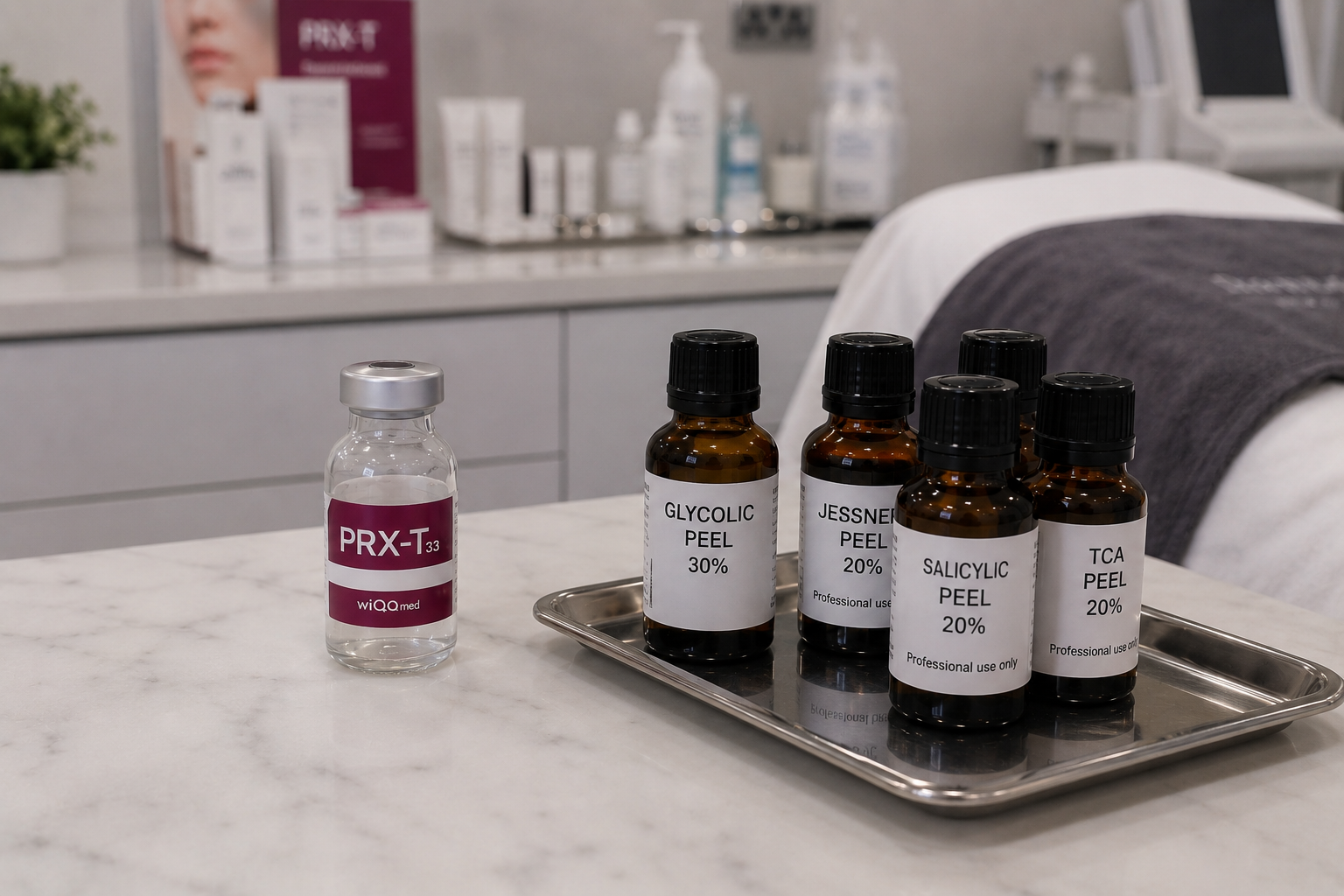
PRX-T33 is a topical skin-rejuvenation treatment developed around a formulation containing trichloroacetic acid (TCA), hydrogen peroxide, and kojic acid.
TCA is well known in aesthetic medicine because it can be used in traditional chemical peels. PRX-T33, however, uses a different formulation and application approach intended to minimize the classic surface effects associated with TCA peeling.
The addition of hydrogen peroxide is designed to modulate the action of TCA and reduce the protein denaturation that typically produces frosting and subsequent exfoliation. This is one of the primary differences between PRX and conventional TCA peeling.
Rather than intentionally removing the outermost layers of skin, PRX is positioned as a biorevitalization treatment that aims to stimulate the skin while preserving the epidermal surface.
For patients researching PRX treatment Darien CT, this distinction is important: PRX should not simply be thought of as a traditional chemical peel with less peeling. Its formulation and intended mechanism are different.
How Does PRX Work?
The easiest way to understand PRX is to think about stimulation versus exfoliation.
Traditional chemical peels primarily work by creating a controlled chemical injury to the skin. Depending on the peel, this can affect the epidermis or extend into the dermis, leading to controlled exfoliation and subsequent regeneration.
PRX takes a different approach.
Its formulation is designed to allow TCA to interact with deeper skin structures while minimizing the typical epidermal damage associated with conventional TCA peeling. Hydrogen peroxide plays an important role in modulating the TCA’s activity, while kojic acid contributes to the formulation’s pigment-focused properties.
The intended result is dermal stimulation without the classic frosting and visible peeling associated with traditional TCA treatments.
This makes PRX particularly interesting for people who want skin rejuvenation but are concerned about treatment downtime.
What Is a Traditional Chemical Peel?
A traditional chemical peel uses a chemical solution to produce a controlled injury to the skin.
The depth of the peel determines how aggressively the skin is treated.
Superficial Peels
Superficial peels primarily affect the outer layers of the epidermis.
They may be used to improve:
- Dull-looking skin
- Uneven tone
- Mild pigmentation
- Some forms of acne
- Rough texture
- Mild photodamage
Common superficial peeling agents include glycolic acid, salicylic acid, lactic acid, and lower-strength TCA formulations.
Medium-Depth Peels
Medium-depth peels penetrate more deeply and can produce more significant resurfacing.
They may be considered for concerns such as:
- More pronounced pigmentation
- Sun damage
- Fine lines
- Certain acne scars
- More noticeable textural irregularities
Because the treatment reaches deeper, recovery is generally more substantial.
Deep Peels
Deep chemical peels create a much more significant injury and require substantially more recovery and medical supervision. The American Academy of Dermatology notes that deep peels can require approximately 14–21 days of healing, with extensive aftercare and follow-up.
Therefore, “chemical peel” is not one single treatment. A superficial glycolic peel and a deep phenol peel have very different mechanisms, indications, risks, and recovery periods.
PRX vs. Traditional Chemical Peel: The Biggest Difference
The key difference is what the treatment is trying to accomplish at the skin surface.
| PRX-T33 | Traditional Chemical Peel |
|---|---|
| Focuses on biostimulation | Focuses on controlled chemical exfoliation |
| Designed to minimize surface peeling | Intentionally exfoliates the treated skin |
| Typically no frosting | Frosting can occur with some TCA peels |
| Minimal visible downtime | Downtime varies by peel depth |
| Designed to stimulate dermal remodeling | Promotes regeneration following controlled injury |
| Can address texture, tone, and signs of aging | Can address pigmentation, acne, texture and photodamage |
| Particularly attractive for patients prioritizing minimal interruption | Can be preferable when stronger resurfacing is the primary goal |
The important point is that PRX and chemical peels are not interchangeable treatments.
A patient seeking deeper resurfacing for significant photodamage may benefit from a conventional peel. Someone primarily interested in skin revitalization with minimal visible recovery may prefer PRX.
PRX and Downtime: Why It Matters
One of the biggest reasons people search for a chemical peel with no downtime is that traditional peeling can interfere with work, social events, travel, exercise, or makeup application.
Recovery depends heavily on the type and depth of chemical peel.
According to the American Academy of Dermatology, a refreshing or “lunchtime” peel can involve approximately 1–7 days of healing, while medium peels may require 7–14 days and deep peels approximately 14–21 days.
During this period, patients may experience redness, scaling, swelling, crusting, or visible peeling depending on the procedure.
PRX is designed specifically to avoid the classic peeling response. Product information describes PRX-T33 as producing no frosting or post-treatment desquamation, although individual patients can still experience temporary skin reactions and should follow their provider’s aftercare instructions.
That makes PRX appealing when minimal downtime is a major treatment priority.
However, “no downtime” should not be interpreted as “no possible side effects.” Individual responses vary, and treatment should always be performed according to the manufacturer’s protocol by an appropriately qualified professional.
PRX vs Peel for Hyperpigmentation: Which Is Better?
This is where the comparison becomes more nuanced.
Both PRX and chemical peels may be considered when the goal is improving the appearance of uneven pigmentation, but hyperpigmentation is not one single condition.
It can include:
- Post-inflammatory hyperpigmentation
- Sun-induced pigmentation
- Melasma
- Acne-related dark marks
- Uneven overall skin tone
- Lentigines
The underlying cause matters.
For example, treating melasma is very different from treating isolated post-acne pigmentation. A provider needs to determine what is actually causing the discoloration before selecting a treatment.
Chemical peels can be useful for certain pigmentary conditions, but the risk of post-inflammatory hyperpigmentation must be considered particularly in patients with darker skin tones. Recent reviews emphasize that superficial peels may be used safely with appropriate patient selection and conservative protocols, while deeper treatments require greater caution.
This is why there is no universal answer to PRX vs peel for hyperpigmentation.
PRX may be attractive when a patient wants a revitalizing treatment with minimal surface disruption, while a carefully selected superficial chemical peel may be more appropriate when controlled exfoliation is specifically desired.
Why Skin Type Matters
Treatment selection should never be based solely on the name of a procedure.
Your provider may consider:
- Fitzpatrick skin type
- History of hyperpigmentation
- Melasma
- Acne or active inflammation
- Previous chemical peels
- Current skincare products
- Recent sun exposure
- Medications
- Skin sensitivity
- Existing barrier damage
- Treatment goals
This is especially important for skin of color.
Research shows that patients with darker skin tones can develop post-inflammatory hyperpigmentation more readily, making careful treatment selection and photoprotection particularly important.
This does not mean people with darker skin cannot have chemical peels. Rather, the peel type, strength, technique, and aftercare should be appropriately individualized.
PRX vs. Chemical Peel for Skin Texture
Texture is another area where the two treatments can overlap.
Traditional chemical peels improve texture through controlled exfoliation and epidermal renewal. This can be particularly useful when the primary concern is a rough or dull surface.
PRX approaches texture from a different direction by emphasizing dermal stimulation and skin revitalization while minimizing visible surface exfoliation.
Therefore:
If your priority is surface resurfacing:
A chemical peel may be a strong option.
If your priority is revitalization with minimal visible peeling:
PRX may be worth considering.
If you have multiple concerns:
Your provider may recommend combining or sequencing different treatments rather than choosing only one.
Can PRX Help With Signs of Aging?
PRX is commonly positioned around concerns associated with skin aging, including:
- Fine lines
- Loss of firmness
- Dullness
- Uneven texture
- Dehydrated-looking skin
- Photoaging
- Reduced skin quality
The rationale is different from simply removing damaged surface cells.
PRX’s formulation is designed to stimulate the dermal environment and support a regenerative response. Manufacturer materials describe TCA as contributing to dermal stimulation and hydrogen peroxide as modulating the effects of TCA.
Early clinical research on PRX-T33 has reported improvements in measures such as skin tone, smoothness, texture, and overall appearance. However, the evidence base is still considerably smaller than the extensive body of research surrounding conventional chemical peeling, and some PRX studies have important limitations such as small sample sizes and lack of controls.
That distinction matters when evaluating treatment claims.
PRX can be a useful aesthetic option, but it should not be presented as a replacement for every resurfacing treatment.
Is PRX Really a “No-Peel” Treatment?
This terminology can be confusing.
PRX-T33 contains TCA, an ingredient historically associated with chemical peeling. However, the PRX formulation is designed so that the TCA does not produce the same epidermal denaturation and frosting typically associated with conventional TCA peeling.
That is why PRX is often described as a non-peeling or no-peel biorevitalization treatment.
The distinction is not simply marketing language. It reflects the intended difference in how the formulation interacts with the skin.
That said, individual skin responses can vary, and some patients may experience temporary dryness, sensitivity, redness, or minor flaking.
How Long Does a PRX Treatment Take?
One reason people choose PRX treatment Darien CT is the relatively short treatment format.
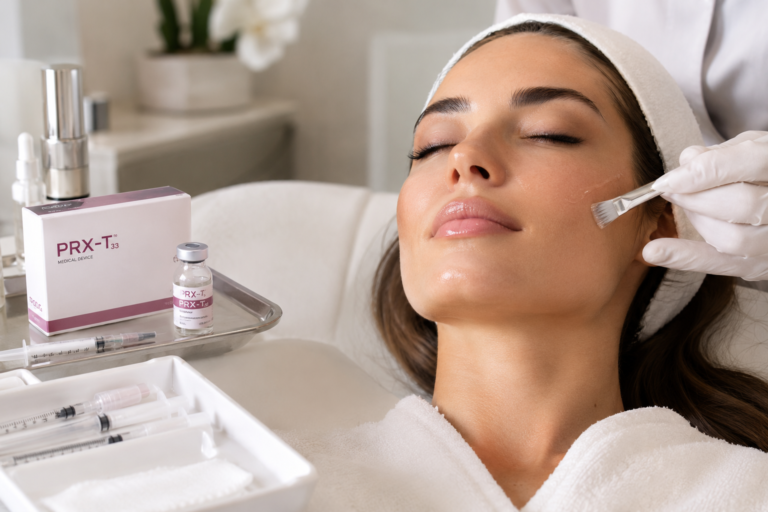
Professional treatment information and clinical protocols describe PRX-T33 as a relatively quick in-office procedure, with the application itself commonly taking around 10–30 minutes, depending on the treatment area and protocol.
A typical appointment may involve:
- Skin assessment
- Cleansing and preparation
- Application of the PRX formulation
- Specific massage/application technique
- Removal or cleansing according to protocol
- Application of appropriate post-treatment skincare
Your provider may recommend a series rather than a single treatment depending on your goals.
The appropriate number and spacing of treatments should be determined individually rather than following a universal schedule.
What About Chemical Peel Recovery?
Traditional chemical peel recovery varies substantially.
A superficial peel may cause mild redness followed by scaling or peeling for several days. A medium peel can cause more pronounced redness, swelling, crusting, and peeling. Deep peels involve considerably more intensive recovery.
This is why it is important to ask:
What type of peel am I actually getting?
Simply hearing “chemical peel” does not tell you how much downtime you will have.
The ingredient, concentration, application technique, penetration depth, and your individual skin response all matter.
PRX vs. Traditional Peel: Which Gives Better Results?
There is no universal winner.
The better treatment is the one that matches the clinical objective.
PRX may be a better fit if you want:
- Minimal visible recovery
- No intentional peeling
- Skin revitalization
- Improved-looking texture
- A more hydrated appearance
- Support for skin firmness
- A treatment that fits into a busy schedule
- A non-needle approach
A traditional chemical peel may be a better fit if you want:
- Controlled exfoliation
- Surface resurfacing
- Treatment of certain pigmentation concerns
- Improvement in rough texture
- Acne-focused exfoliation
- More aggressive resurfacing when clinically appropriate
The important distinction is biostimulation versus exfoliation.
Is PRX a Chemical Peel Alternative in CT?
For patients searching for a chemical peel alternative CT, PRX can be an option worth discussing with a qualified provider.
It is particularly relevant for people who like the idea of professional skin rejuvenation but do not want significant visible peeling.
However, PRX should not automatically replace chemical peels.
A superficial peel may still be the more appropriate option for a patient whose primary concern is epidermal pigmentation, acne, or surface texture. Another patient may benefit more from PRX because their main goals are skin revitalization, firmness, and minimal downtime.
The best approach is individualized treatment planning rather than choosing a procedure simply because it has less downtime.
Can PRX Be Used in Summer?
PRX is often promoted as a treatment that can be performed throughout the year because it is designed not to produce the same photosensitizing or peeling response as conventional resurfacing treatments. (Kuulas Skin)
However, that does not mean sun protection becomes optional.
Daily broad-spectrum sunscreen, sensible sun avoidance, and following your provider’s post-treatment instructions remain important for maintaining skin health and reducing the risk of pigmentary changes.
This is especially important for anyone prone to hyperpigmentation or melasma.
What Are the Risks?
Every professional skin treatment has potential risks.
With chemical peels, possible complications include:
- Persistent redness
- Temporary darkening or lightening of the skin
- Irritation
- Infection
- Scarring
- Post-inflammatory hyperpigmentation
The American Academy of Dermatology emphasizes that the skill and experience of the person performing the peel are important factors in achieving safe outcomes. (American Academy of Dermatology)
PRX is designed to minimize the visible epidermal injury associated with traditional peeling, but it is still an active professional treatment. Temporary irritation, redness, dryness, or sensitivity can occur.
Patients with a history of pigmentary complications should discuss that history before treatment.
PRX vs. Chemical Peel: A Simple Decision Guide
If you are still deciding between the two, consider your primary objective.
Choose PRX when your priority is:
Minimal visible downtime + skin revitalization + firmness + hydration + smoother-looking skin.
Consider a superficial chemical peel when your priority is:
Controlled exfoliation + surface pigmentation + acne-related concerns + rough texture.
Consider a stronger peel only when appropriate:
More significant resurfacing may require a deeper procedure, but the increased intensity also means increased recovery and potential complications.
The goal should never be to choose the strongest treatment available.
The goal is to choose the least aggressive treatment capable of appropriately addressing your concern.
What Should You Ask During a PRX Consultation?
Before undergoing PRX treatment Darien CT, consider asking:
1. What is causing my skin concern?
Pigmentation, dehydration, photoaging, acne, and laxity require different approaches.
2. Is PRX or a chemical peel better for my skin type?
Your Fitzpatrick skin type and history of hyperpigmentation can influence treatment selection.
3. What type of chemical peel would I be comparing PRX with?
A superficial glycolic peel is very different from a medium-depth TCA peel.
4. How much downtime should I realistically expect?
Ask about redness, dryness, peeling, makeup, exercise, and sun exposure.
5. How many treatments might I need?
Treatment plans should be customized to your skin and goals.
6. What should I stop using before treatment?
Retinoids, exfoliating acids, benzoyl peroxide, and other active products may need to be adjusted depending on your provider’s protocol.
7. What is the aftercare plan?
Proper aftercare is part of the treatment, not an optional extra.
The Bottom Line: PRX or Traditional Chemical Peel?
PRX and traditional chemical peels can both improve the appearance of skin, but they do so in fundamentally different ways.
Traditional chemical peels rely on controlled chemical exfoliation and injury to stimulate regeneration. The depth of the peel determines both the expected results and the recovery period.
PRX-T33 uses a formulation containing TCA, hydrogen peroxide, and kojic acid designed to provide dermal biostimulation while minimizing the surface exfoliation and frosting associated with conventional TCA peels.
For someone looking for PRX treatment Darien CT, the biggest advantage may be the ability to pursue skin revitalization without intentionally creating visible peeling.
For someone whose main goal is aggressive resurfacing, pigmentation management, or controlled epidermal exfoliation, a traditional chemical peel may still be the more appropriate choice.
Ultimately, PRX is not necessarily better than a chemical peel it is simply a different approach.
The right choice depends on your skin, your concern, your tolerance for downtime, and your desired outcome.
If you are considering PRX treatment Darien CT, a professional consultation can help determine whether PRX, a chemical peel, or another treatment is the most appropriate option for your skin.
Your best treatment is not the most aggressive one. It is the one that matches your skin’s needs.
Frequently Asked Questions About PRX Treatment Darien CT
Is PRX the same as a chemical peel?
No. PRX-T33 contains TCA, but its formulation is designed to minimize the epidermal denaturation and visible peeling associated with conventional TCA peels. It is generally positioned as a non-peeling biorevitalization treatment. (PubMed Central (PMC))
Does PRX cause peeling?
PRX is specifically formulated to avoid the typical frosting and desquamation associated with traditional TCA peeling. Individual skin responses can vary, however, so your provider should explain what to expect based on your skin.
Is PRX good for hyperpigmentation?
PRX may be considered for certain pigmentation concerns, but the underlying cause matters. Melasma, post-inflammatory hyperpigmentation, and sun spots are not identical conditions and should not automatically be treated the same way.
Is PRX better than a chemical peel for hyperpigmentation?
Not necessarily. A carefully selected superficial chemical peel may be appropriate for certain pigmentary concerns, while PRX may be more attractive when the goal includes overall skin revitalization with minimal visible peeling. Your skin type and pigmentation history should be considered before choosing either treatment.
How much downtime does PRX have?
PRX is designed as a no-peel treatment with minimal visible downtime. Temporary redness, dryness, or sensitivity may still occur. (Kuulas Skin)
How much downtime does a chemical peel have?
It depends on the depth. The AAD reports approximately 1–7 days for a refreshing peel, 7–14 days for a medium peel, and 14–21 days for a deep peel. (American Academy of Dermatology)
Can people with darker skin have chemical peels?
Yes, but treatment should be carefully selected and performed by an experienced professional. Research indicates that darker skin types can have a higher risk of pigmentary complications, particularly with deeper or more aggressive procedures. (PubMed Central (PMC))
Is PRX a good alternative to chemical peels in CT?
It can be a useful option for patients seeking professional skin rejuvenation with minimal visible peeling. However, it is not a universal substitute for chemical peels because the treatments have different mechanisms and indications.