
When it comes to facial rejuvenation, not every regenerative treatment works the same way. PRP, standard PRF, and PRF EZ Gel all use components derived from your own blood, but they differ in preparation, consistency, composition, and how they are used.
One of the most common areas of interest is the under-eye area. The skin beneath the eyes is naturally thin and delicate, making concerns such as hollowness, fine lines, dark circles, and loss of volume particularly noticeable. While traditional fillers may be an option for certain patients, regenerative treatments offer another approach to improving the appearance of the skin.
For patients researching PRF eye gel Stamford CT, understanding the difference between these three treatments can make it easier to know what each option is designed to do.
At Versailles Medical Spa, we believe that choosing the right treatment starts with understanding how it works, what it can address, and what kind of results may be realistic.
What Are PRP, Standard PRF, and PRF EZ Gel?
Before comparing the three treatments, it helps to understand what they have in common.
PRP, or Platelet-Rich Plasma, and PRF, or Platelet-Rich Fibrin, are autologous treatments. This means they are prepared using a small sample of the patient’s own blood.
After collection, the blood is processed in a centrifuge to separate specific components. These preparations contain varying concentrations of platelets, growth factors, and other blood-derived components.
The main difference comes down to how the blood is processed and how the final preparation behaves when injected.
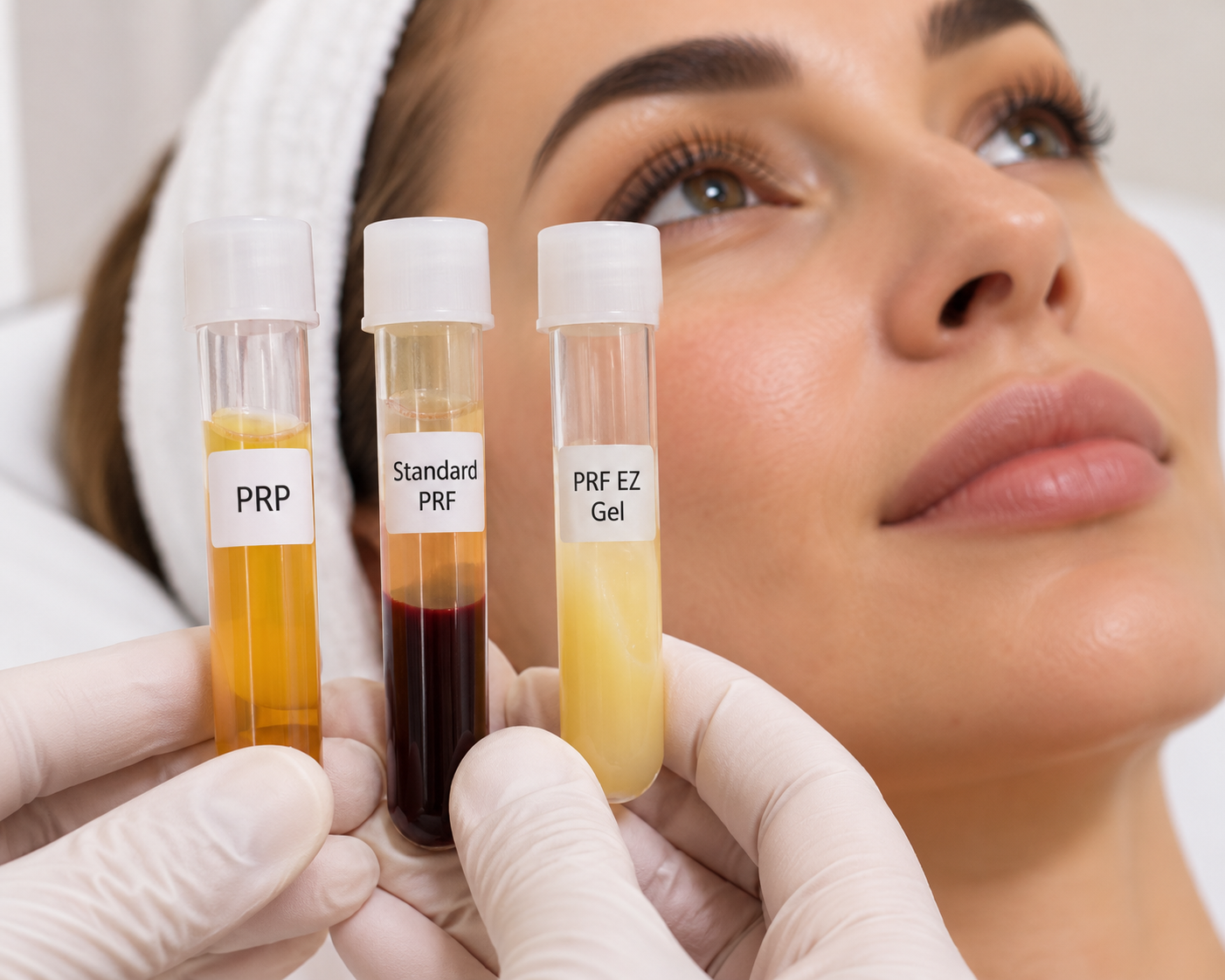
- PRP: A liquid platelet concentrate commonly used to support skin and tissue rejuvenation.
- Standard PRF: A fibrin-based preparation that creates a natural matrix containing platelets and other blood components.
- PRF EZ Gel: A specially prepared, gel-like form of PRF designed to provide a thicker consistency for certain areas where additional support and subtle volume may be desired.
Although they share a similar starting point, they are not interchangeable treatments.
What Is PRP (Platelet-Rich Plasma)?
PRP stands for Platelet-Rich Plasma. It is one of the most established blood-derived regenerative treatments used in aesthetic medicine.
The process begins with a small blood draw. The sample is placed in a centrifuge, where it is processed to separate platelet-rich plasma from other blood components.
The resulting preparation is a liquid concentrate containing platelets and growth factors.
Platelets play an important role in the body’s natural healing process. When activated, they release signaling proteins and growth factors involved in tissue repair and cellular activity.
In aesthetic applications, PRP is commonly used to support:
- Skin texture and overall skin quality.
- The appearance of fine lines.
- Skin rejuvenation in selected areas of the face.
- Scalp treatments aimed at supporting hair growth.
- Recovery and rejuvenation protocols when combined with certain procedures.
How Does PRP Work?
PRP delivers a concentrated preparation of platelets to the targeted treatment area. These platelets release growth factors and other signaling molecules that participate in the body’s natural tissue-repair processes.
In facial aesthetics, PRP is generally used as a regenerative treatment rather than a traditional volumizing treatment.
For example, a patient concerned about crepey under-eye skin or early signs of aging may be evaluated for PRP as part of a broader skin rejuvenation plan.
However, PRP does not function like a hyaluronic acid filler. It does not provide the same immediate structural volume or predictable contouring effect.
This distinction is particularly important for patients comparing PRF gel vs PRP for face, especially when their primary concern is under-eye hollowness rather than skin texture alone.
What Is Standard PRF (Platelet-Rich Fibrin)?
Standard PRF stands for Platelet-Rich Fibrin. It is considered a second-generation platelet concentrate because its preparation differs from traditional PRP.
Unlike PRP, standard PRF is generally prepared without anticoagulants. A blood sample is collected and centrifuged promptly, allowing the natural clotting process to create a fibrin matrix.
This fibrin structure acts as a biological scaffold that holds platelets and other blood components within its network.
How Does Standard PRF Work?
The fibrin matrix is an important part of what makes PRF different from PRP.
Rather than simply delivering a liquid platelet concentrate, PRF creates a structure that can support the gradual release of growth factors over time.
Depending on the preparation method, PRF can be produced in different forms:
- Solid PRF: A fibrin clot or membrane that can be used in certain regenerative and surgical applications.
- Injectable PRF (i-PRF): A temporarily liquid preparation that can be injected before its fibrin network forms.
- Liquid PRF: A preparation designed to remain injectable for a limited period, depending on the centrifugation protocol.
In aesthetic medicine, injectable PRF is used in selected facial rejuvenation treatments to support improvements in skin texture, fine lines, and overall skin quality.
What Makes PRF Different From PRP?
The main distinction is the fibrin structure.
PRP is primarily a liquid platelet concentrate prepared using anticoagulants. Standard PRF is prepared without anticoagulants and develops a fibrin network that contains platelets and other blood components.
This difference influences the preparation, consistency, and release characteristics of each product.
For patients exploring PRF eye gel Stamford CT, it is important to understand that standard injectable PRF and PRF EZ Gel are not the same. Although both are derived from PRF, their final consistency and intended aesthetic applications can differ.
What Is PRF EZ Gel?
PRF EZ Gel is a specialized preparation that combines liquid PRF with a processed protein component from the patient’s own blood to create a thicker, gel-like consistency.
It is particularly interesting in facial aesthetics because it brings together two treatment concepts:
- The regenerative properties associated with platelet-rich fibrin.
- A thicker consistency that can provide subtle, temporary support in selected areas.
This is why PRF EZ Gel is often discussed as an option for patients interested in under-eye rejuvenation and addressing mild volume-related concerns.
How Is PRF EZ Gel Prepared?
The preparation process generally involves two stages.
Step 1: Blood collection and PRF preparation
A small blood sample is collected and processed to obtain injectable PRF. This preparation contains platelets, fibrin-related components, and other blood-derived elements.
Step 2: Creating the gel consistency
A separate portion of the patient’s blood is processed to obtain plasma proteins, which are then heated under controlled conditions to denature albumin and create a gel-like material.
The processed albumin is combined with liquid PRF to produce the final PRF EZ Gel preparation.
The resulting material has a thicker consistency than standard liquid PRF.
Importantly, the precise preparation ratios, heating parameters, and centrifugation protocols may vary depending on the system and clinical technique being used.
Why Is PRF EZ Gel Used for the Under-Eye Area?
The under-eye area is one of the most delicate areas of the face. The skin is thin, the underlying structures are complex, and even subtle changes in volume can affect the overall appearance.
Some patients experience:
- Under-eye hollowness.
- A tired-looking appearance.
- Fine lines and crepey skin.
- Mild volume loss.
- Changes in skin quality associated with aging.
PRF EZ Gel may be considered for appropriately selected patients who want a conservative approach to under-eye rejuvenation.
Its thicker consistency makes it different from liquid PRF, while its blood-derived composition distinguishes it from conventional synthetic fillers.
However, it is important to understand that PRF EZ Gel is not equivalent to hyaluronic acid filler. Its volumizing effect is generally more subtle and less predictable, and the clinical evidence for actual volume restoration is still developing.
For individuals researching PRF eye gel Stamford CT, this distinction matters: the treatment is not simply another version of traditional under-eye filler. It is a different approach that combines a gel-like preparation with platelet-based regenerative components.
PRF Gel vs. PRP for Face: What Are the Main Differences?
Although both treatments use the patient’s own blood, they serve somewhat different purposes in aesthetic medicine.
The most important difference is that PRP is primarily a liquid regenerative preparation, while PRF EZ Gel has a thicker consistency designed to offer additional support in selected treatment areas.
Here is a closer comparison:
| Feature | PRP | Standard PRF | PRF EZ Gel |
|---|---|---|---|
| Starting material | Patient’s blood | Patient’s blood | Patient’s blood |
| Anticoagulant | Generally used | Generally not used | Depends on the preparation of each component |
| Main structure | Liquid platelet concentrate | Fibrin matrix | Gel-like albumin and PRF preparation |
| Consistency | Liquid | Clot, membrane, or temporary liquid | Thicker gel |
| Primary aesthetic focus | Skin rejuvenation | Regenerative skin support | Regenerative support with subtle volume |
| Under-eye application | Selected cases | Selected cases | Selected cases, especially mild hollowing |
| Traditional filler equivalent? | No | No | No |
1. Preparation
PRP requires anticoagulants to prevent the blood from clotting during processing. Standard PRF is generally prepared without anticoagulants, allowing the natural formation of a fibrin structure.
PRF EZ Gel involves an additional preparation step to create its thicker consistency.
2. Texture and Consistency
PRP remains liquid, making it suitable for injection into targeted areas as a platelet concentrate.
Standard PRF can be prepared as a solid fibrin matrix or as an injectable liquid, depending on the technique.
PRF EZ Gel has a thicker, gel-like consistency that distinguishes it from both preparations.
3. Treatment Goals
PRP is generally selected for skin-quality concerns and regenerative applications.
Standard PRF is also used for skin rejuvenation, with particular interest in improving fine lines, texture, and crepiness.
PRF EZ Gel may be considered when a patient has both skin-quality concerns and mild under-eye volume loss.
4. Expected Results
All three treatments work differently from traditional dermal fillers.
PRP and standard PRF are primarily regenerative treatments. PRF EZ Gel introduces an additional gel-like component that may provide subtle support, but it should not be expected to create the same degree of volume as a conventional filler.
Results vary depending on the patient’s anatomy, skin condition, treatment technique, and individual response.
For patients comparing PRF eye gel Stamford CT options, the right choice depends on whether the main concern is skin quality, pigmentation, fine lines, or actual volume loss.
PRF EZ Gel vs. Traditional Under-Eye Filler
One of the biggest questions patients have when considering PRF eye gel Stamford CT is whether PRF EZ Gel can replace traditional under-eye filler.
The answer depends on the type of concern being treated.
Traditional hyaluronic acid (HA) fillers are designed to restore volume and improve facial contours. They can be useful for selected patients with under-eye hollows, but they are not suitable for everyone.
PRF EZ Gel offers a different approach.
Rather than using a manufactured hyaluronic acid product, it uses a preparation derived from the patient’s own blood. Its gel-like consistency may provide subtle support while the PRF component contributes to the regenerative treatment approach.
Here are some important differences:
Traditional HA Under-Eye Filler
- Uses hyaluronic acid to restore volume.
- Provides more immediate and predictable structural correction.
- Can be used to address selected tear trough hollows.
- Can be dissolved with hyaluronidase when appropriate.
- Requires careful patient selection because of potential swelling, vascular complications, and other injection-related risks.
PRF EZ Gel
- Uses components derived from the patient’s own blood.
- Creates a gel-like preparation through controlled processing.
- May provide subtle support in selected areas.
- Is not designed to produce the same degree of volume as conventional fillers.
- Cannot be reversed using hyaluronidase like HA filler.
For patients researching PRF under-eye filler Darien CT, the key question is whether they need structural volume restoration or a more conservative regenerative approach.
Neither option is universally better. An experienced provider should evaluate the under-eye anatomy, degree of volume loss, skin thickness, and medical history before recommending treatment.
Who Is a Good Candidate for PRF EZ Gel?
PRF EZ Gel may be appropriate for patients who want to address early signs of under-eye aging without necessarily choosing traditional dermal fillers.
Potential candidates may include individuals experiencing:
- Mild under-eye hollowness.
- Fine lines and crepey skin.
- Early volume changes.
- A tired-looking appearance associated with under-eye changes.
- A preference for treatments prepared using their own blood.
However, PRF EZ Gel is not suitable for every type of under-eye concern.
For example, significant tear trough volume loss, prominent fat pads, under-eye bags, excess skin, or genetic pigmentation may require a different treatment approach.
Dark circles are also not always caused by volume loss. They may result from pigmentation, visible blood vessels, skin thickness, or shadowing caused by facial anatomy.
This is why a consultation is essential before choosing a treatment.
For those searching for PRF eye gel Stamford CT, a personalized assessment helps determine whether PRF EZ Gel, PRP, standard PRF, or another treatment is more appropriate.
What Results Can You Expect From PRF EZ Gel?
PRF EZ Gel results can develop differently from traditional dermal fillers.
With HA fillers, volume correction is generally visible shortly after treatment, although swelling and settling can temporarily affect the appearance.
With PRF EZ Gel, the gel itself provides an initial physical component, while the PRF preparation is intended to support regenerative processes.
Patients may notice changes in the appearance of under-eye hollowness, skin texture, and fine lines over time. However, the extent of improvement varies.
Several factors influence the outcome:
Individual anatomy: The amount of natural volume beneath the eyes, skin thickness, and facial structure all influence the result.
Treatment technique: Injection depth, placement, and preparation protocols matter, particularly in the delicate periorbital region.
Age and skin condition: Existing skin laxity and the degree of volume loss can affect treatment suitability.
Individual response: Because the preparation uses the patient’s own blood components, results are not identical from one person to another.
PRF EZ Gel should not be presented as a guaranteed solution for dark circles, deep hollows, or significant under-eye bags.
How Many PRF EZ Gel Sessions Are Needed?
The number of sessions depends on the patient’s starting condition and treatment goals.
Some treatment protocols involve an initial series of sessions rather than a single appointment. The interval between treatments and the need for maintenance should be determined by the treating provider.
It is also important to understand that long-term results are still being studied. There is currently insufficient high-quality evidence to establish one universal treatment schedule or guarantee a specific duration of results.
Is PRF EZ Gel Safe?
Because PRF EZ Gel is prepared using the patient’s own blood, it is an autologous treatment. This reduces concerns related to introducing a synthetic filler material, but it does not eliminate the risks associated with injections.
Possible temporary side effects include:
- Swelling.
- Bruising.
- Tenderness.
- Redness.
- Temporary unevenness or small lumps.
More serious complications, including infection, vascular injury, and tissue damage, are possible with facial injections. The under-eye area requires particular anatomical expertise because of its complex blood supply.
Treatment should only be performed by an appropriately trained and qualified medical professional using proper preparation, sterile technique, and careful injection protocols.
Patients considering PRF eye gel Stamford, CT should also discuss relevant medical conditions, medications, bleeding tendencies, and any previous filler treatments during their consultation.
What Does the Research Say About PRP and PRF for Under-Eye Rejuvenation?
Research into platelet-based treatments for facial rejuvenation continues to develop, particularly for PRF eye gel Stamford CT, an increasingly explored option for under-eye rejuvenation.
A 2025 systematic review published in the Journal of Cosmetic Dermatology evaluated 14 studies comparing PRP and PRF for periorbital rejuvenation.
The review found that:
- PRF showed promising improvements in skin texture, fine lines, and crepiness.
- PRP demonstrated stronger evidence for improving periorbital hyperpigmentation.
- Both treatments generally showed favorable safety profiles in the included studies.
- The long-term durability of results remains uncertain.
The researchers also emphasized that larger, standardized clinical studies are needed before definitive conclusions can be made about which treatment is superior.
It is important to distinguish these findings from the evidence for PRF EZ Gel specifically. Research on PRP and standard PRF does not automatically establish the effectiveness or longevity of the additional gel preparation.
For patients exploring PRF eye gel Stamford CT, this distinction is particularly relevant when considering treatment for under-eye volume loss, fine lines, and changes in skin texture.
PRF EZ Gel vs. PRP vs. Standard PRF: Which Treatment Is Right for You?
There is no single treatment that works best for everyone. The right choice depends on the concern being addressed and the type of improvement a patient wants.
Here is a simple way to understand the differences:
Choose PRP when: The primary goal is skin rejuvenation and improving overall skin quality, with additional applications depending on the treatment area.
Consider standard PRF when: The goal is regenerative skin support, particularly for concerns such as fine lines, skin texture, and crepiness.
Consider PRF EZ Gel when: The patient has selected under-eye concerns involving mild hollowness and skin quality and may benefit from a thicker, gel-like preparation.
For patients exploring PRF under eye filler Darien CT, the decision should always be based on an individual assessment rather than choosing a treatment simply because it is trending.
At Versailles Medical Spa, we take an individualized approach to facial rejuvenation, considering your anatomy, skin condition, and aesthetic goals before recommending a treatment.
Explore Under-Eye Rejuvenation at Versailles Medical Spa
Understanding the difference between PRP, standard PRF, and PRF EZ Gel is the first step toward making an informed treatment decision.
Whether you are concerned about under-eye hollowness, fine lines, crepey skin, or changes in skin quality, the best approach starts with understanding what is causing the concern.
If you are researching PRF eye gel Stamford CT, Versailles Medical Spa offers personalized aesthetic consultations to help you explore appropriate treatment options.
Our team serves patients in Darien and surrounding Fairfield County communities who are interested in modern, personalized aesthetic treatments.
Ready to explore your options?
Schedule a consultation with Versailles Medical Spa to discuss your under-eye concerns and find out whether PRF EZ Gel or another rejuvenation treatment may be right for you.
Call 203-202-7688 or visit versaillesmedicalspa.com to get started.